Patient information · Vein conditions
Understanding thread veins (spider veins)
Thread veins — also known as spider veins or telangiectasia — are small, visible veins that appear close to the surface of the skin. They often look like thin red, blue, or purple lines and tend to appear on the legs or face. While generally harmless, they can occasionally cause discomfort or indicate an underlying vein problem.
What are thread veins?
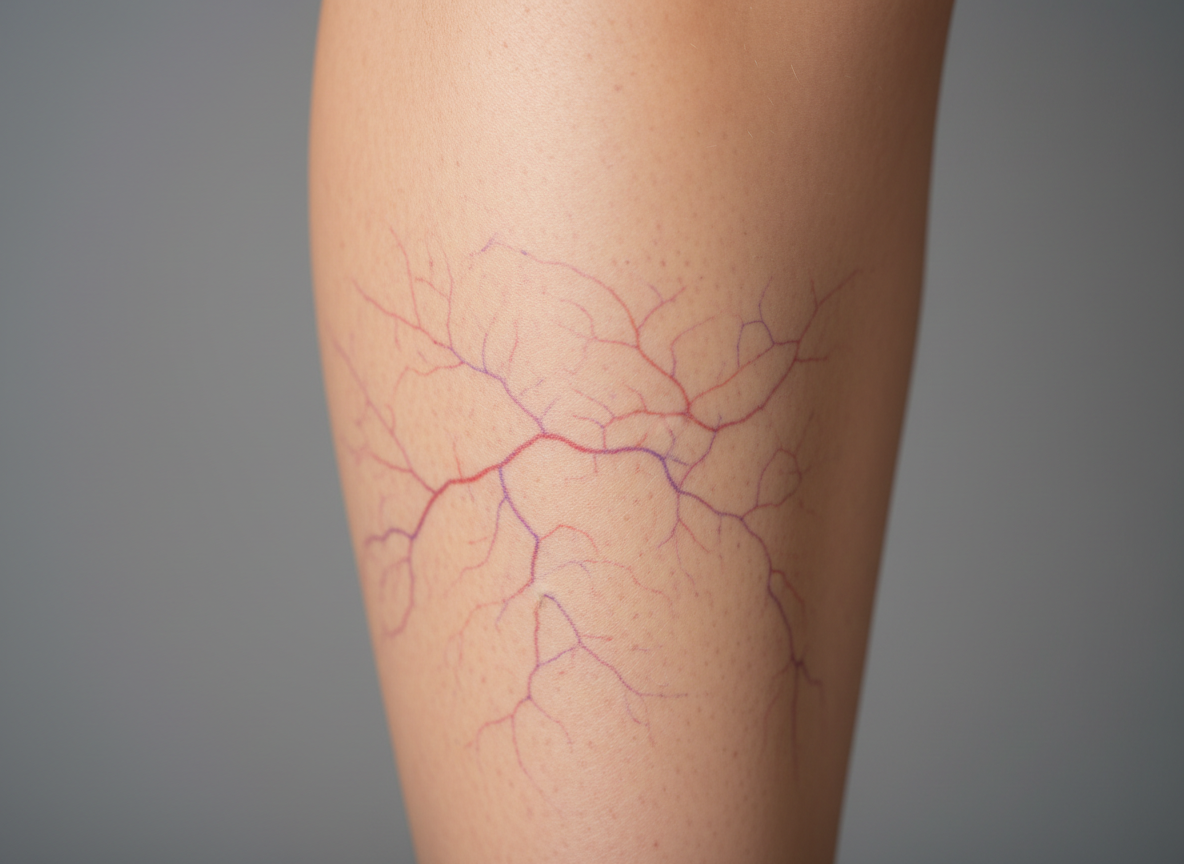
Thread veins (also called spider veins or telangiectasia) are tiny, dilated blood vessels that appear on the surface of the skin. Unlike varicose veins, they are usually flat and do not bulge. They often resemble a spider's web, spreading out in clusters, and can vary in colour from red to dark purple.
These veins develop when the walls of small veins weaken, causing them to dilate and become visible through the skin. Blood can pool in these weakened vessels, making them permanently visible. Thread veins are most common on the thighs, calves, ankles, and face — particularly around the nose and cheeks.
How thread veins develop
Thread veins form when the walls of small veins weaken. This can be due to back pressure from larger veins — sometimes these larger veins are visible as bulging varicose veins, but they can also be hidden varicose veins that are not visible at the skin surface. Genetic factors also play an important role.
When vein walls become weak or damaged, blood can flow backwards and collect in the vein. This extra pressure causes the vein walls to expand and become visible through the skin. Factors like hormonal changes, prolonged standing, injury, or excess pressure can speed up this process.
On the face, thread veins often result from tiny blood vessels becoming weakened due to sun exposure, extreme weather, or certain skin conditions like rosacea. Over time, these weakened veins become permanent unless treated.
Thread veins vs varicose veins
Thread veins and varicose veins are related but distinct conditions. Thread veins are smaller (typically less than 1 mm in diameter), sit closer to the skin surface, and are usually flat. Varicose veins are larger, raised, and often blue or green. Both can be caused by valve problems, but varicose veins are more likely to cause symptoms such as aching, swelling, and skin changes.
Importantly, thread veins can sometimes be a sign of underlying varicose veins that are not visible at the surface. This is why a duplex ultrasound scan is often recommended before treatment — to check whether there is a deeper vein problem feeding the thread veins.
Key facts about thread veins
- Also known as
- Spider veins, telangiectasia, broken veins, reticular veins (slightly larger)
- Size
- Typically less than 1 mm in diameter — much smaller than varicose veins
- Appearance
- Thin red, blue, or purple lines, often in web-like clusters
- Common locations
- Thighs, calves, ankles, and face (especially nose and cheeks)
- Prevalence
- Extremely common — affects up to 80% of adults, particularly women
- Treatment
- Microsclerotherapy (legs) or thermocoagulation (face) — quick, minimally invasive procedures
Could there be a deeper problem?
Thread veins can sometimes be fed by underlying varicose veins that are not visible at the skin surface. Treating the thread veins alone without addressing the underlying cause may mean they return. A duplex ultrasound scan can identify whether deeper veins need to be treated first.
Signs and symptoms
The most obvious sign of thread veins is the appearance of thin, web-like veins on the skin surface. While thread veins are usually painless, some people report mild symptoms that can affect daily comfort.
The most obvious sign is the appearance of thin, red, purple, or blue lines on the skin surface, often in clusters or branching patterns.
Some people experience a dull ache or feeling of heaviness in the legs, particularly after prolonged standing or by the end of the day.
The skin over and around thread veins can become itchy, dry, or produce a mild burning sensation.
A general feeling of tiredness or heaviness in the legs, especially after standing for long periods or in warm weather.
Occasional throbbing sensations or night cramps in the calves, which may be associated with underlying venous pressure.
For many people, the primary issue is appearance. Thread veins can affect confidence, particularly when they develop on visible areas like the face or lower legs.
When symptoms may worsen
Thread vein symptoms can vary from mild to bothersome depending on your lifestyle, overall vein health, and daily habits. You may notice symptoms becoming worse:
Jobs that involve long periods on your feet increase venous pressure
Heat causes veins to dilate, making thread veins more visible and symptomatic
Hormonal changes and increased blood volume put extra pressure on leg veins
Without treatment, thread veins tend to increase in number and may become more noticeable
Causes and risk factors
Thread veins develop for a variety of reasons, and often there is more than one contributing factor. Understanding what causes them can help guide treatment and may help prevent new thread veins from developing.
If your parents or close relatives have thread veins or varicose veins, you are significantly more likely to develop them. Inherited weakness in vein walls is one of the strongest risk factors.
Fluctuations in hormones, particularly oestrogen and progesterone, can weaken vein walls. This is why thread veins are more common during pregnancy, menopause, and in women taking hormonal contraception or hormone replacement therapy (HRT).
Jobs or lifestyles that involve long periods of standing or sitting reduce the natural muscle-pump action that helps blood return to the heart, increasing pressure in the leg veins.
As we age, the walls of our veins naturally lose elasticity and become weaker. The valves inside the veins may also become less efficient, allowing blood to pool and veins to dilate.
Ultraviolet (UV) radiation from the sun can damage the skin and weaken the walls of small blood vessels, particularly on the face. This is a common cause of facial thread veins.
During pregnancy, blood volume increases significantly and hormonal changes relax vein walls. The growing uterus also puts pressure on the veins in the pelvis, which can increase pressure in the leg veins.
Carrying extra body weight increases the pressure on the veins in the legs, making it harder for blood to flow efficiently back to the heart.
Direct injury to the skin or underlying tissue can damage small blood vessels, leading to the development of thread veins in the affected area.
Risk factors you should know
While thread veins can happen to anyone, certain factors make them more likely to appear. These risk factors either weaken the vein walls or increase the pressure in your veins, making it harder for blood to flow properly.
- Female sex (thread veins are more common in women than men)
- Family history of vein problems
- Occupations involving prolonged standing (e.g. teaching, nursing, retail)
- Multiple pregnancies
- Use of hormonal contraception or HRT
- Obesity or being significantly overweight
- A sedentary lifestyle with limited physical activity
- History of deep vein thrombosis (DVT) or previous vein injury
- Excessive sun exposure, particularly for facial thread veins
How thread veins are diagnosed
While thread veins are visible on the skin surface and can often be identified by sight alone, it is important to check for any underlying vein issues before deciding on treatment.
Clinical examination
During your consultation, Mr Sidloff will examine the areas affected by thread veins. This involves looking at the size, location, and pattern of the veins and asking questions about your symptoms, medical history, and lifestyle.
If you experience any pain, swelling, or leg fatigue, these may indicate a need for further investigation. The clinician will also check for signs of underlying vein disease, such as varicose veins or poor circulation.
Duplex ultrasound scan
A duplex ultrasound scan may be recommended to assess the deeper veins in your legs. This test uses sound waves to create images of the blood flow and detect any valve problems or blockages.
The scan is painless, non-invasive, and helps determine if there is a condition like chronic venous insufficiency or hidden varicose veins that could be feeding your thread veins. If deeper issues are found, these may need to be treated first for the best long-term result.
Why diagnosis matters before treatment
Treating thread veins without first checking for underlying vein problems can lead to disappointing results. If hidden varicose veins are feeding the thread veins, the thread veins are likely to return after treatment. A proper assessment ensures that the root cause is addressed, giving you the best chance of a lasting result.
Treatment options
Thread veins do not resolve on their own. If you would like to reduce their appearance or address associated symptoms, several effective, minimally invasive treatments are available. The right approach depends on the size, location, and number of veins, as well as whether there is an underlying vein problem.
Conservative management
For those with mild or non-bothersome thread veins, conservative approaches can help improve symptoms and slow the development of new veins. These options do not remove existing thread veins but are helpful for managing discomfort:
- Regular exercise to improve circulation and strengthen the calf muscle pump
- Compression stockings to support blood flow and reduce venous pressure
- Elevating your legs when resting to help blood drain back towards the heart
- Maintaining a healthy weight to reduce pressure on leg veins
- Avoiding prolonged standing or sitting where possible
- Wearing sun protection on the face to prevent UV damage to small blood vessels
Microsclerotherapy (legs)
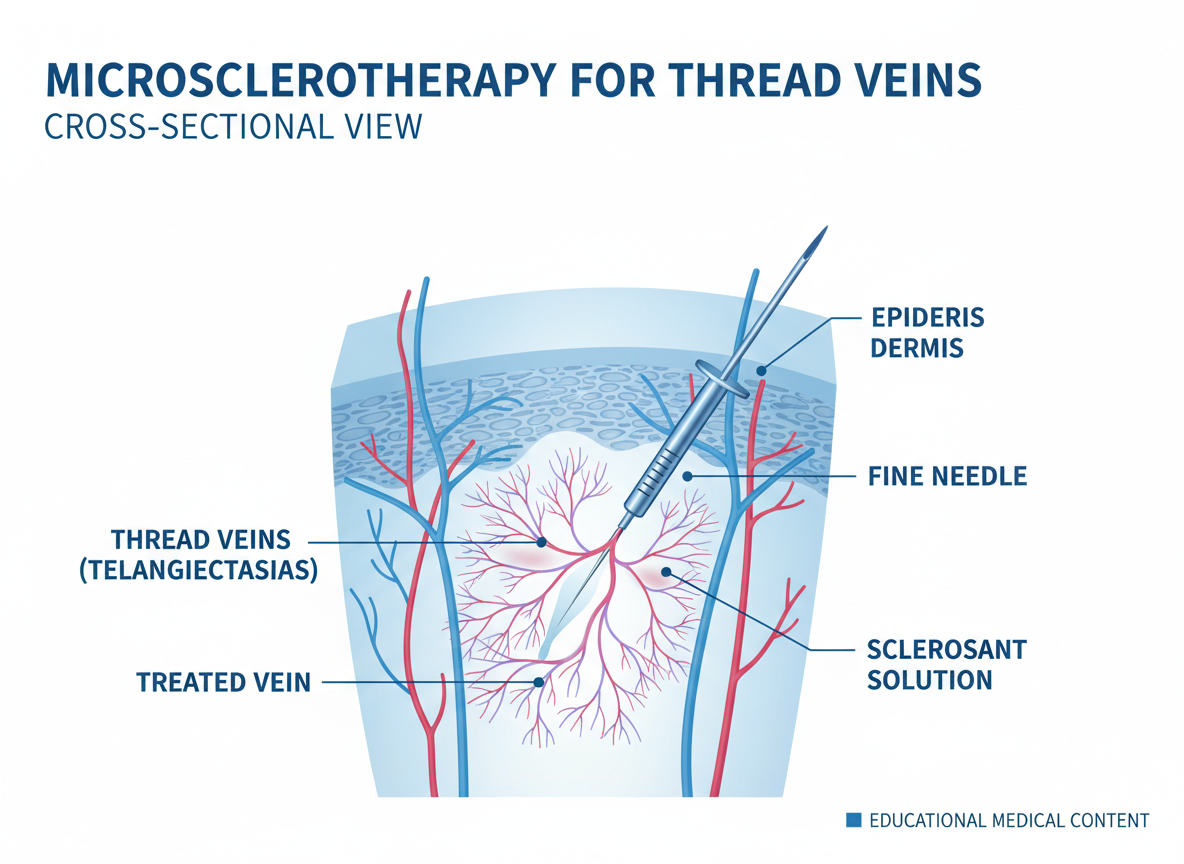
The gold-standard treatment for thread veins on the legs. A sclerosant solution is injected directly into the thread vein using a very fine needle. The solution irritates the vein lining, causing it to collapse, seal shut, and gradually be absorbed by the body over the following weeks.
- Performed with a very fine needle (similar to an acupuncture needle)
- No anaesthetic usually needed
- Sessions typically take 15 to 30 minutes
- Multiple veins can be treated in a single session
- Results develop gradually over 6 to 12 weeks
- Most patients need 2 to 4 sessions for optimal results
Foam sclerotherapy
For slightly larger thread veins or reticular (feeder) veins, foam sclerotherapy may be used. The sclerosant is mixed with air to create a foam, which displaces blood more effectively and stays in contact with the vein wall for longer, producing a stronger seal.
- Particularly effective for larger thread veins and feeder veins
- Performed under ultrasound guidance when needed
- Can be combined with microsclerotherapy in the same session
- Walk-in, walk-out procedure
Thermocoagulation (face and delicate areas)
For thread veins on the face, thermocoagulation uses a very fine insulated needle to deliver controlled bursts of radiofrequency energy directly into each spider vein. The heat causes the vein to seal and disappear. This technique is particularly well suited for small veins on delicate areas like the nose and cheeks.
- Uses radiofrequency energy via a fine insulated needle
- Ideal for facial thread veins (nose, cheeks, chin)
- Minimal discomfort (mild pricking or heating sensation)
- No injection of chemicals into the skin
- Quick sessions with minimal downtime
Risks and side effects
Thread vein treatments are safe and well-established. Like any medical procedure, they carry some risks. Most side effects are mild and temporary. Serious complications are rare.
Common side effects
Mild bruising around the injection sites is common and expected. It usually fades over one to three weeks.
Some localised redness, swelling, or tenderness at the treatment sites is normal in the first few days.
Brownish marks may develop along the treated veins due to iron deposits from trapped blood. This usually fades over several months but can occasionally persist longer.
In some cases, a cluster of very fine new thread veins may appear near the treatment site. This is called matting and usually resolves on its own or with further treatment.
Less common and rare risks
If the sclerosant leaks outside the vein into surrounding tissue, it can occasionally cause a small area of skin damage. This is uncommon and usually heals, though it may leave a small scar.
Allergic reactions to the sclerosant are extremely rare. Your clinician will ask about any known allergies before treatment.
There is a very small risk of a blood clot forming in the deep veins. This is minimised by compression stockings and early walking after the procedure.
A small number of patients experience temporary visual disturbance (flickering lights or blurred patches) shortly after injection. This is similar to a migraine aura, typically lasts 10 to 30 minutes, and resolves completely. It is more common in patients who suffer from migraines.
Recovery and what to expect afterwards
Recovery from thread vein treatment is generally very straightforward. Because the procedures are minimally invasive, most patients resume their normal routine almost immediately.
Recovery timeline
Can thread veins come back after treatment?
Thread veins that have been successfully treated will not return. However, new thread veins can develop over time because the underlying factors that contribute to them — such as genetics, ageing, or lifestyle habits — are still present.
Frequently asked questions
Answers to the questions patients most commonly ask about thread vein assessment and treatment.
Is microsclerotherapy painful?
Most patients describe a mild stinging or pricking sensation as the needle enters the skin — similar to an insect bite. No anaesthetic is usually needed. The procedure is generally well tolerated, and any discomfort passes quickly.
How many treatment sessions will I need?
Most patients need between 2 and 4 sessions for thread veins on the legs, spaced several weeks apart. The exact number depends on the extent of your thread veins and how they respond to treatment. Your clinician will advise on this at your follow-up appointment.
Can I drive home after treatment?
Yes. Because microsclerotherapy does not require anaesthetic, you can drive yourself home. You are encouraged to walk for a short period before leaving the clinic.
How soon can I return to work?
Most people return to work the same day or the next day. There are no restrictions on desk-based work. If your job involves heavy lifting or prolonged standing, you may want to take a day or two off.
When will I see results?
Results develop gradually. Treated veins often look worse before they look better — they may appear darker or more prominent initially as the body begins to absorb them. Most patients see significant improvement within 6 to 12 weeks.
Will the thread veins come back?
Thread veins that have been successfully treated will not return. However, new thread veins can develop over time, particularly if the underlying factors (genetics, hormones, lifestyle) are still present. Treating any deeper vein problems and maintaining a healthy lifestyle can help reduce recurrence.
Can thread veins on the face be treated the same way?
Facial thread veins are usually treated with thermocoagulation rather than microsclerotherapy. This technique uses radiofrequency energy delivered through a fine insulated needle and is particularly well suited for the delicate skin on the face.
I get migraines — is treatment safe for me?
Microsclerotherapy can be performed in patients who experience migraines, but there is a slightly higher chance of temporary visual disturbance (similar to a migraine aura) after the injection. Please mention your migraine history at your consultation so your clinician can take this into account.
Are thread veins a sign of something more serious?
In most cases, thread veins are a cosmetic concern. However, they can sometimes indicate underlying venous insufficiency or hidden varicose veins. A duplex ultrasound scan can rule out deeper problems and ensure you receive the most appropriate treatment.
Can thread veins be prevented?
While it may not be possible to completely prevent thread veins — especially if you have a strong family history — there are steps you can take to reduce your risk and delay their development.
- Stay physically active — regular walking, swimming, or cycling strengthens the calf muscle pump and improves circulation
- Avoid prolonged standing or sitting — take regular breaks to move around and flex your calves
- Maintain a healthy weight — excess weight increases pressure on the veins in your legs
- Wear compression stockings if advised — particularly if you stand for long periods at work
- Elevate your legs when resting — this helps blood drain back towards the heart
- Protect your skin from the sun — UV exposure weakens small blood vessels, particularly on the face
- Avoid excessive heat — hot baths, saunas, and prolonged sun exposure can dilate veins and worsen thread veins
- Eat a balanced diet rich in fibre — this supports healthy circulation and prevents constipation (which can increase venous pressure)
- Avoid crossing your legs for long periods — this can restrict blood flow
- Wear comfortable, supportive footwear — avoid very high heels for extended periods
Why early intervention matters
Spotting thread veins early can make a big difference in managing them effectively and preventing them from becoming more widespread. Many people ignore the first signs, thinking they are just cosmetic. However, these visible veins may be an early sign of underlying vein weakness or poor circulation.
- Simpler treatment — fewer veins are easier and quicker to treat
- Better results — early treatment often produces more complete clearance
- Identify deeper problems — early assessment can catch hidden varicose veins before they cause further damage
- Prevent spread — addressing the cause early can slow the development of new thread veins
When to seek medical advice
You should consider seeing a vascular specialist if you notice:
- • Thread veins that are spreading or increasing in number
- • Persistent aching, heaviness, or swelling in your legs
- • Skin changes around the ankles (discolouration, thickening)
- • Thread veins accompanied by visible varicose veins
- • Symptoms that affect your daily comfort or confidence
Concerned about thread veins?
A specialist consultation can confirm what is causing your thread veins, check for any underlying vein problems, and help you understand your treatment options. Initial consultations are typically available within five days.
If you have urgent symptoms (e.g. sudden leg swelling, significant bleeding from a varicose vein), please seek urgent NHS assessment via 111 or A&E.