Patient information · Varicose vein treatment
Foam sclerotherapy
Foam sclerotherapy is a minimally invasive injection treatment for varicose veins. A specially prepared foam is injected directly into the affected vein under ultrasound guidance, causing it to seal shut and be gradually absorbed by the body. It is performed as a walk-in, walk-out procedure with no incisions required.
What is foam sclerotherapy?
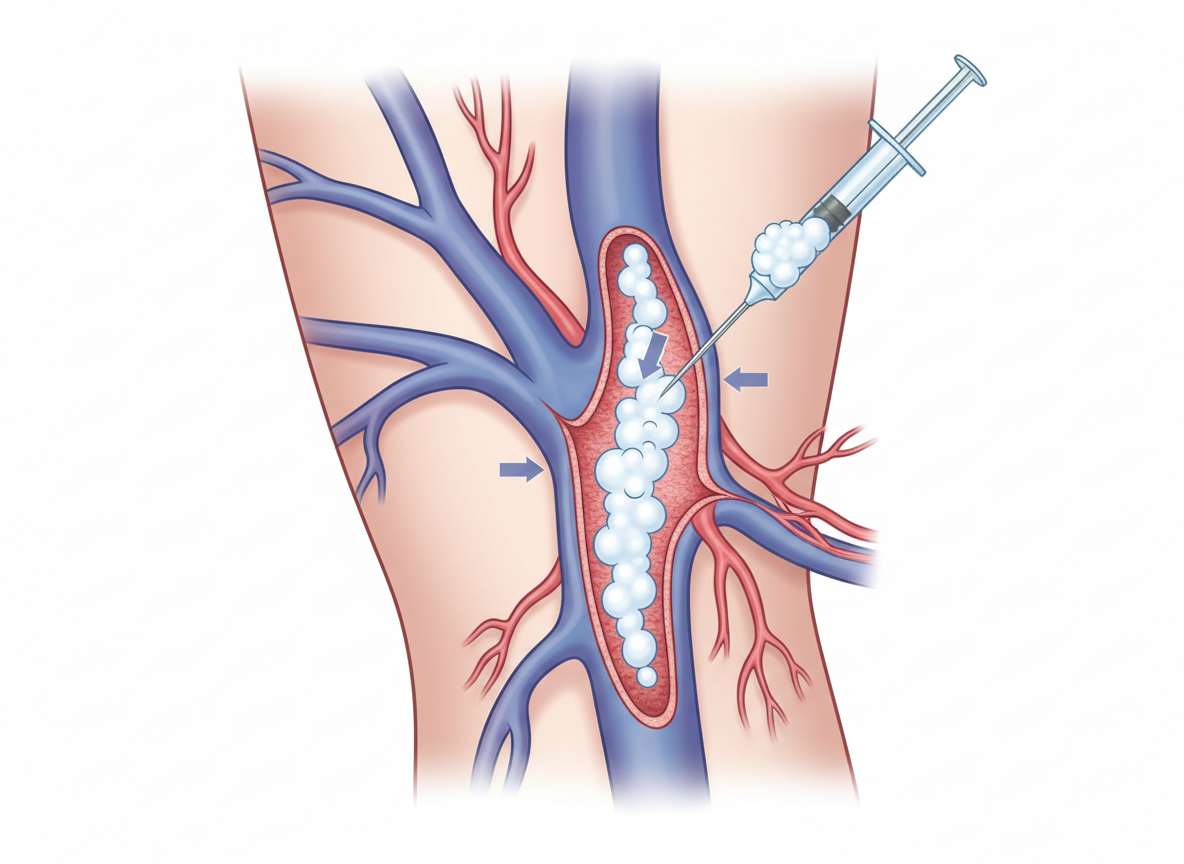
Foam sclerotherapy is an injection-based treatment for varicose veins. A liquid sclerosant (Fibrovein) is mixed with a small amount of air to create a foam. This foam is then injected directly into the varicose vein under ultrasound guidance.
The foam displaces blood from the vein and comes into contact with the vein wall, causing irritation and inflammation. This triggers the vein to close, stick together, and eventually be absorbed by the body over the following weeks. Blood is naturally rerouted through healthy veins nearby.
Why foam rather than liquid?
The foam formulation is more effective than liquid sclerotherapy for larger varicose veins. Because foam is thicker than liquid, it displaces blood more effectively and stays in contact with the vein wall for longer. This means a stronger, more reliable seal — particularly in veins that are too large for liquid injection alone.
Foam sclerotherapy can be used as a standalone treatment or as part of a combined approach alongside radiofrequency ablation (RFA) and/or avulsions. Your surgeon will recommend the best combination based on your duplex ultrasound findings.
Key facts about foam sclerotherapy
- Product used
- Fibrovein (sodium tetradecyl sulphate) — a well-established sclerosant used widely in the UK
- Technique
- Ultrasound-guided injection of foam directly into the varicose vein using a fine needle
- Anaesthetic
- Usually no anaesthetic is needed — the injection is similar to a blood test
- Duration
- Typically 15–30 minutes
- Setting
- Day-case procedure — walk-in, walk-out
- Scarring
- None — no incisions, just a fine needle puncture
Foam sclerotherapy vs. RFA
RFA uses heat to seal the main trunk vein, while foam sclerotherapy uses a chemical foam. They treat different parts of the problem and are often used together. RFA is typically used for the main refluxing vein (e.g. the great saphenous vein), while foam sclerotherapy is particularly effective for branch veins, recurrent veins, and veins that are difficult to access with a catheter.
What happens during the procedure
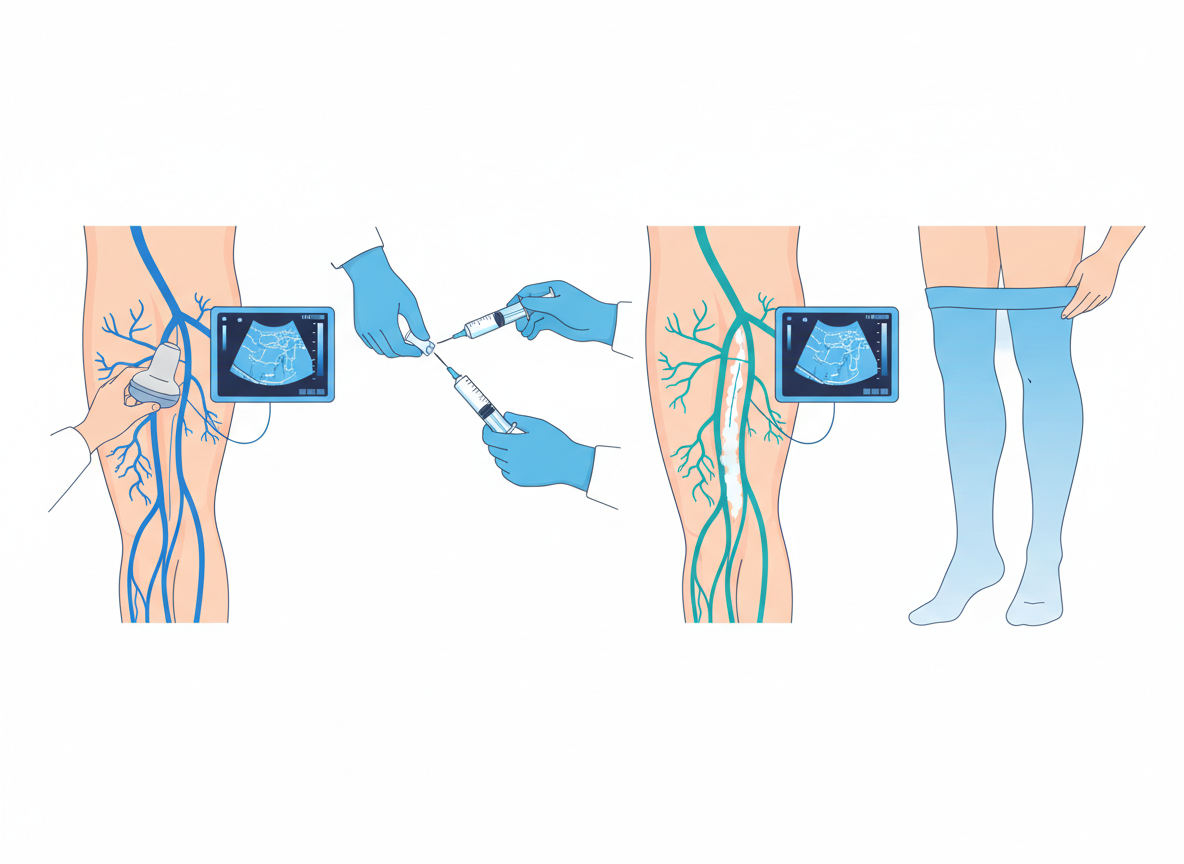
Foam sclerotherapy is one of the quickest and simplest varicose vein treatments. Here is what to expect on the day, step by step.
Duplex ultrasound mapping
Before the procedure, a duplex ultrasound scan confirms which veins are affected and maps the areas to be treated. This ensures the foam is injected precisely into the correct veins.
Foam preparation
The sclerosant (Fibrovein) is mixed with a small volume of air using a technique called the Tessari method. This creates a microfoam with a consistency similar to shaving foam. The foam is freshly prepared immediately before injection.
Ultrasound-guided injection
With the ultrasound probe on your leg, the surgeon inserts a fine needle into the varicose vein and injects the foam under direct vision. You may feel a mild stinging or warm sensation as the foam enters the vein. The foam displaces blood and coats the vein wall, causing it to spasm and close.
Compression and mobilisation
After the injections, a compression bandage or stocking is applied immediately. You are asked to walk for a short period before going home. The compression helps keep the treated vein closed and promotes healing. You can drive and resume normal activities the same day.
No anaesthetic usually needed
Unlike radiofrequency ablation or avulsions, foam sclerotherapy usually does not require any local anaesthetic. The injection itself is similar to having a blood test — a brief, mild sting from the needle. Some patients feel a slight warming or tingling sensation as the foam enters the vein, but this passes quickly.
The entire procedure typically takes just 15 to 30 minutes, depending on how many veins are being treated. Most patients are surprised by how quick and straightforward it is.
Risks and side effects
Foam sclerotherapy is a safe, well-established treatment with a strong track record. Like any medical procedure, it carries some risks. Most side effects are mild and temporary. Serious complications are rare.
Your surgeon will discuss these with you before the procedure and answer any questions. Understanding the risks is an important part of making an informed decision.
Common side effects
These are expected and usually resolve on their own within days to weeks.
Some bruising along the treated veins is normal and expected. It can look quite colourful initially but usually fades over one to three weeks.
Soreness or a feeling of tightness along the treated veins is common in the first few days. Over-the-counter painkillers are usually sufficient.
The treated veins may feel firm or lumpy under the skin as they close and are absorbed. This is a normal part of the healing process and softens over several weeks.
Brownish staining may develop along the line of the treated veins. This is caused by iron deposits from trapped blood and usually fades over several months, though it can occasionally persist longer.
Less common and rare risks
These occur infrequently but are important to be aware of.
The treated vein can become inflamed, red, and tender. This is usually self-limiting and responds to anti-inflammatory medication and compression. It is part of the intended treatment effect but can occasionally be more pronounced.
Small pockets of trapped blood may form in the treated vein. These can feel like tender lumps. If needed, they can be drained with a small needle at a follow-up appointment to relieve discomfort and speed healing.
A small number of patients experience temporary visual disturbance (such as flickering lights or blurred patches) shortly after the injection. This is similar to a migraine aura, typically lasts 10–30 minutes, and resolves completely. It is more common in patients who suffer from migraines.
In some cases, the brownish discolouration along the treated vein can take many months to fade, or may persist as a faint mark. This is more likely if trapped blood is not drained early.
If foam leaks into very small veins near the skin surface, it can occasionally cause a small area of skin damage or ulceration. This is uncommon and usually heals, though it may leave a small scar.
There is a very small risk of a blood clot forming in the deep veins. This is minimised by compression stockings and early walking after the procedure.
Allergic reactions to the sclerosant (Fibrovein) are extremely rare. Your surgeon will ask about any known allergies before the procedure.
How we minimise risk
Every injection is performed under real-time ultrasound guidance, ensuring the foam is delivered precisely into the correct vein and reducing the risk of it entering unintended vessels.
The amount of foam used is carefully controlled to minimise the risk of foam reaching the deep veins or causing excessive inflammation.
Compression stockings and immediate walking after the procedure reduce the risk of blood clots and help the treated veins close effectively.
A note for migraine sufferers
If you experience migraines with aura, please mention this at your consultation. Patients with a history of migraine aura may have a slightly higher chance of temporary visual disturbance after foam sclerotherapy. Your surgeon will take this into account when planning your treatment.
Recovery and what to expect afterwards
Recovery from foam sclerotherapy is generally very straightforward. Because there are no incisions and no anaesthetic, most patients resume their normal routine almost immediately.
Recovery timeline
Walk-in, walk-out — no overnight stay
Foam sclerotherapy is one of the quickest and simplest varicose vein treatments available. You arrive at the clinic, have the injections, and walk out typically within 30 to 45 minutes. There is no anaesthetic to recover from, no incisions to heal, and no need for anyone to drive you home.
Frequently asked questions
Answers to the questions patients most commonly ask about foam sclerotherapy.
Is foam sclerotherapy painful?
Most patients describe it as no worse than a blood test. You feel a brief sting from the needle, and some people notice a mild warming or tingling sensation as the foam enters the vein. No anaesthetic is usually needed. Afterwards, mild tenderness along the treated veins is common for a few days.
How many sessions will I need?
Many patients achieve a good result with a single session. However, some veins may need a second treatment, particularly if there are multiple branches or if the veins are extensive. Your surgeon will advise on this at your follow-up appointment.
Can I drive home after the procedure?
Yes. Because foam sclerotherapy does not require anaesthetic, you can drive yourself home. You are encouraged to walk for a short period before leaving the clinic.
How soon can I return to work?
Most people return to work the same day or the next day. There are no restrictions on desk-based work. If your job involves heavy lifting or prolonged standing, you may want to take a day or two off.
Will I need time off exercise?
Walking is encouraged from the day of treatment. Light exercise can usually be resumed within a day or two. More strenuous activities (running, gym, swimming) are typically fine after one to two weeks, depending on your surgeon’s advice.
What happens to the treated veins?
The foam causes the vein walls to stick together and close. Over the following weeks and months, the body gradually absorbs the closed vein. Blood is naturally rerouted through healthy veins nearby — your circulation is not affected.
Will the veins come back?
Veins that have been successfully treated with foam sclerotherapy are permanently closed. However, new varicose veins can develop over time in other areas, particularly if there is an underlying tendency towards venous reflux. Treating the root cause (e.g. with RFA) alongside foam sclerotherapy helps reduce this risk.
Can foam sclerotherapy be used on its own?
Yes, in some cases foam sclerotherapy is the only treatment needed. It is particularly effective for branch veins, recurrent veins, and veins that are difficult to access with a catheter. However, it is most commonly used alongside radiofrequency ablation (RFA) and/or avulsions for a comprehensive result.
I get migraines — is foam sclerotherapy safe for me?
Foam sclerotherapy can be performed in patients who experience migraines, but there is a slightly higher chance of temporary visual disturbance (similar to a migraine aura) after the injection. Please mention your migraine history at your consultation so your surgeon can take this into account.
Considering foam sclerotherapy?
The first step is a consultation and duplex ultrasound scan to confirm which veins are affected and whether foam sclerotherapy (alone or combined with other treatments) is the right approach. Initial consultations are typically available within five days.
If you have urgent symptoms (e.g. sudden leg swelling, significant bleeding from a varicose vein), please seek urgent NHS assessment via 111 or A&E.