Patient information · Varicose vein treatment
Avulsions (phlebectomy)
Avulsions — also known as phlebectomies or ambulatory phlebectomy — is a minimally invasive technique for removing visible, bulging varicose veins through tiny incisions in the skin. It is performed under local anaesthetic as a walk-in, walk-out procedure.
What are avulsions (phlebectomy)?
Avulsions — sometimes called phlebectomies, ambulatory phlebectomy, or micro-phlebectomy — is a technique for physically removing varicose veins that are visible and bulging beneath the skin. Unlike radiofrequency ablation or foam sclerotherapy (which seal veins from the inside), avulsions involve gently extracting the vein through tiny puncture incisions.
The procedure targets the surface branch veins that cause the visible, lumpy appearance most people associate with varicose veins. It is often performed alongside treatment of the underlying refluxing vein (such as RFA) to achieve a comprehensive result — addressing both the root cause and the visible symptoms.
Why are avulsions needed?
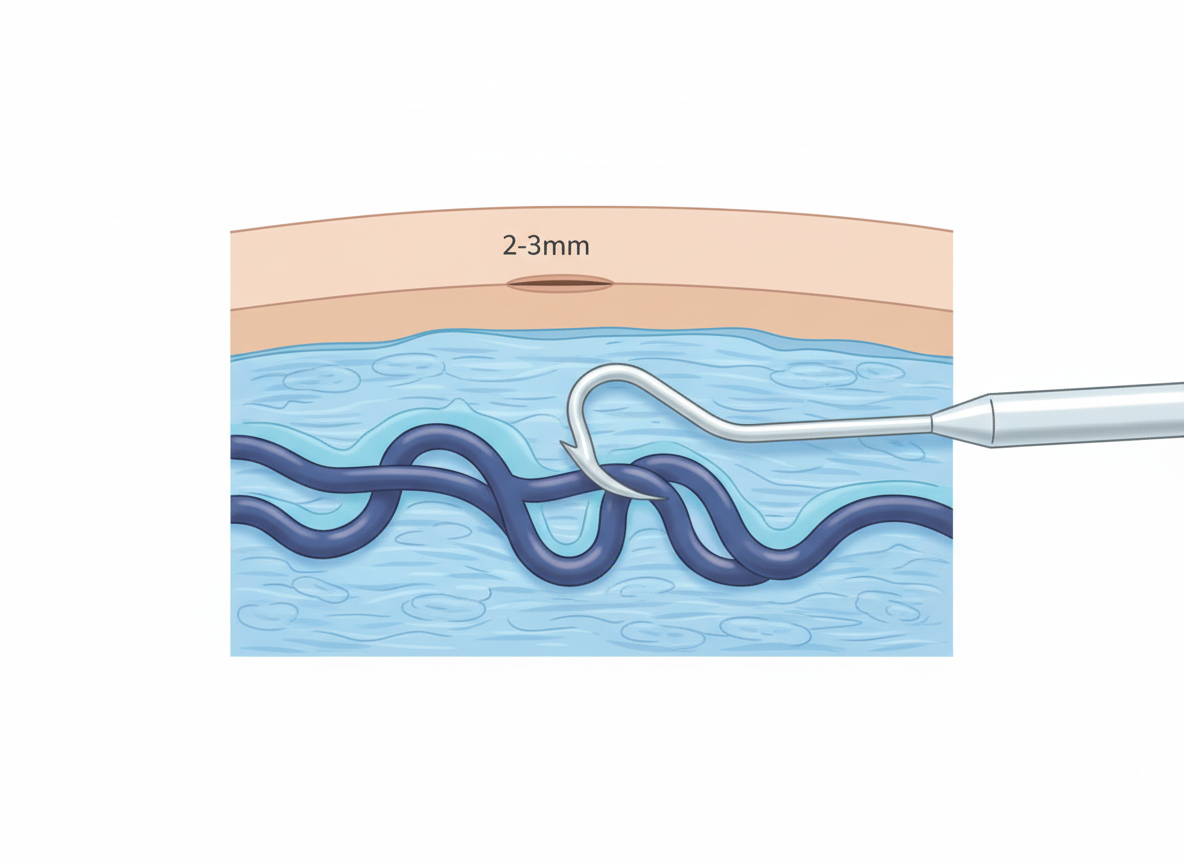
When varicose veins are large, prominent, or close to the skin surface, they may not respond as well to injection-based treatments alone. Avulsions provide an immediate, visible improvement by physically removing the bulging veins. Because the incisions are so small (typically 2–3 mm), the cosmetic result is excellent and stitches are rarely needed.
In many cases, avulsions are combined with radiofrequency ablation (RFA) in the same session. RFA seals the main refluxing vein (the source of the problem), while avulsions remove the visible branch veins. Together, they treat both the cause and the appearance in a single visit.
Key facts about avulsions
- Technique
- Surface varicose veins are removed through tiny 2–3 mm incisions using a small hook or forceps
- Anaesthetic
- Local anaesthetic only — no general anaesthetic required
- Duration
- Typically 30–60 minutes, depending on the number of veins treated
- Setting
- Day-case procedure — walk-in, walk-out
- Scarring
- Minimal — tiny incisions that heal to near-invisible marks; stitches are rarely needed
- Often combined with
- Radiofrequency ablation (RFA) and/or foam sclerotherapy for a complete treatment plan
Avulsions vs. traditional vein stripping
Avulsions are very different from the older “vein stripping” operations that many people remember. Vein stripping involved larger incisions, general anaesthetic, and a longer recovery. Modern avulsions use micro-incisions, local anaesthetic, and allow you to walk out the same day with minimal downtime.
What happens during the procedure
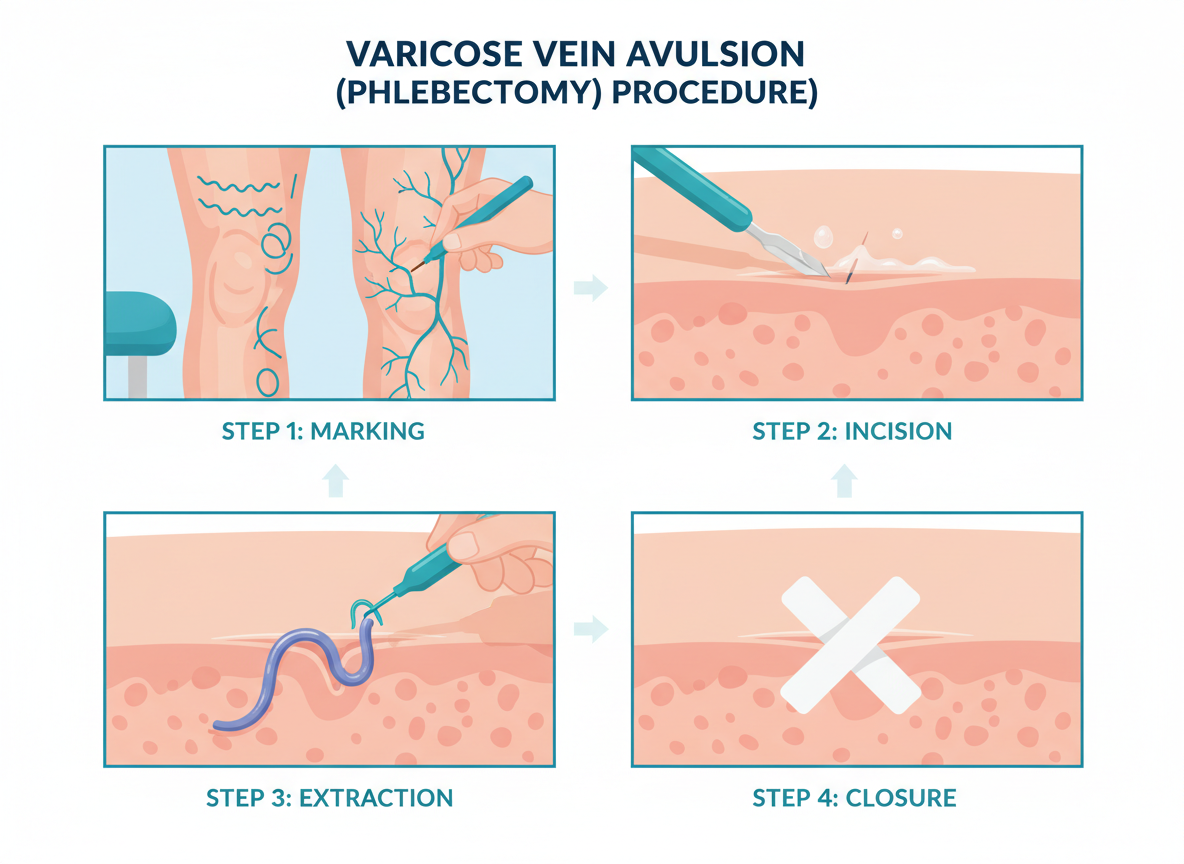
Avulsions are a straightforward, well-established procedure. Here is what to expect on the day, step by step.
Marking the veins
Before the procedure, your surgeon marks the varicose veins on your leg while you are standing. This is important because varicose veins are most visible and prominent when you are upright. The markings act as a precise guide during the procedure.
Local anaesthetic
The skin along the marked veins is numbed using local anaesthetic. You stay awake and comfortable throughout. If avulsions are being performed alongside RFA, the tumescent anaesthesia used for the ablation often provides sufficient numbing for both procedures.
Vein removal through micro-incisions
Tiny incisions (typically 2–3 mm) are made along the course of the varicose vein. A small hook or forceps is used to gently tease the vein out through each incision. The vein is removed in segments. Because the incisions are so small, the vein slides out with minimal tissue disruption.
Closure and compression
The micro-incisions are closed with adhesive strips (Steri-Strips) or a simple dressing — stitches are rarely needed. A compression bandage or stocking is applied to support healing and minimise bruising. You can stand up and walk immediately.
Often combined with RFA in the same session
In many patients, the best results come from treating both the underlying refluxing vein (with radiofrequency ablation) and the visible surface veins (with avulsions) at the same time. When performed together, the RFA is usually done first to seal the main faulty vein, followed immediately by avulsions to remove the prominent branches. This combined approach addresses both the root cause and the visible symptoms in a single visit.
Your surgeon will explain whether a combined approach is appropriate for your veins based on your duplex ultrasound findings.
Risks and side effects
Avulsions are a safe, well-established procedure with a strong track record. Like any medical treatment, they carry some risks. Most side effects are mild and temporary. Serious complications are rare.
Your surgeon will discuss these with you before the procedure and answer any questions. Understanding the risks is an important part of making an informed decision.
Common side effects
These are expected and usually resolve on their own within days to weeks.
Bruising along the treated areas is normal and expected. It can look quite dramatic initially but usually fades over one to three weeks.
Soreness along the areas where veins have been removed is common in the first few days. Over-the-counter painkillers are usually sufficient.
Some localised swelling around the treated areas is normal, particularly in the first week. Compression stockings and gentle walking help this settle.
You may feel small, firm lumps where veins have been removed. These are areas of trapped blood (haematoma) and are harmless. They soften and disappear over several weeks.
Less common and rare risks
These occur infrequently but are important to be aware of.
Brownish staining may develop along the line of the removed veins. This is caused by iron deposits from trapped blood and usually fades over several months.
Small sensory nerves near the treated veins may be temporarily affected. This usually resolves within weeks to months, though occasionally it can persist longer.
As with any procedure involving skin incisions, there is a small risk of infection. Sterile technique and wound care minimise this risk. Signs to watch for include increasing redness, warmth, or discharge.
Inflammation along the path of a treated vein can cause localised redness, warmth, and tenderness. This is usually self-limiting and responds to anti-inflammatory medication.
There is a very small risk of a blood clot forming in the deep veins. This is minimised by early mobilisation (walking) and compression stockings after the procedure.
The micro-incisions typically heal to near-invisible marks. In rare cases, some patients may develop slightly more visible scars, particularly those prone to keloid or hypertrophic scarring.
How we minimise risk
Veins are carefully marked while you are standing, ensuring only the correct veins are treated and reducing the chance of unnecessary incisions.
Incisions of just 2–3 mm minimise tissue disruption, reduce scarring risk, and promote faster healing compared to larger surgical approaches.
Compression stockings and immediate mobilisation after the procedure reduce the risk of blood clots and help bruising resolve more quickly.
Recovery and what to expect afterwards
Recovery from avulsions is generally quick and straightforward. Because the incisions are so small and the procedure is performed under local anaesthetic, most patients are back to their normal routine within days.
Recovery timeline
Walk-in, walk-out — no overnight stay
Avulsions are a true day-case procedure. You arrive at the hospital, have the treatment, and go home the same day. There is no overnight stay, no general anaesthetic recovery, and no need for someone to collect you in most cases. The procedure itself typically takes 30–60 minutes, and you are usually ready to leave within an hour or two.
Frequently asked questions
Answers to the questions patients most commonly ask about avulsions (phlebectomy).
Are avulsions painful?
The local anaesthetic injections are the most uncomfortable part — similar to a dental injection. Once the area is numb, you should not feel pain during the procedure. Afterwards, mild soreness and tenderness are common for a few days and are usually well managed with paracetamol or ibuprofen.
Will I need stitches?
Usually not. The incisions are typically just 2–3 mm and are closed with adhesive strips (Steri-Strips) or a small dressing. These tiny wounds heal well without sutures and leave minimal scarring.
Can I drive home after the procedure?
In most cases, yes. Because avulsions are performed under local anaesthetic, most patients are able to drive themselves home. Your surgeon will confirm this on the day based on the extent of the procedure.
How soon can I return to work?
Most people return to desk-based work within one to three days. If your job involves heavy lifting or prolonged standing, your surgeon may recommend a slightly longer break — typically up to a week.
Will I need time off exercise?
Walking is encouraged from day one. Light exercise can usually be resumed within a few days. More strenuous activities (running, gym, swimming) are typically fine after one to two weeks, depending on your surgeon’s advice.
How many incisions will I need?
This depends on the number and length of the varicose veins being treated. Your surgeon will explain this during your consultation. Each incision is tiny (2–3 mm) and is placed along the course of the vein.
Will the veins come back?
Veins that have been physically removed cannot regrow. However, new varicose veins can develop over time in other areas, particularly if there is an underlying tendency towards venous reflux. Treating the root cause (e.g. with RFA) alongside avulsions helps reduce this risk.
Can avulsions be done on their own?
Yes, in some cases avulsions are performed as a standalone procedure. However, they are most commonly combined with radiofrequency ablation (RFA) or foam sclerotherapy to treat both the underlying reflux and the visible surface veins for the best overall result.
Considering avulsions for your varicose veins?
The first step is a consultation and duplex ultrasound scan to confirm which veins are affected and whether avulsions (alone or combined with other treatments) are the right approach. Initial consultations are typically available within five days.
If you have urgent symptoms (e.g. sudden leg swelling, significant bleeding from a varicose vein), please seek urgent NHS assessment via 111 or A&E.