Patient information · Varicose vein treatment
Radiofrequency ablation (RFA)
Radiofrequency ablation is a minimally invasive treatment that uses controlled heat to seal varicose veins from the inside. It is performed under local anaesthetic as a walk-in, walk-out procedure — with most patients back on their feet immediately.
What is radiofrequency ablation?
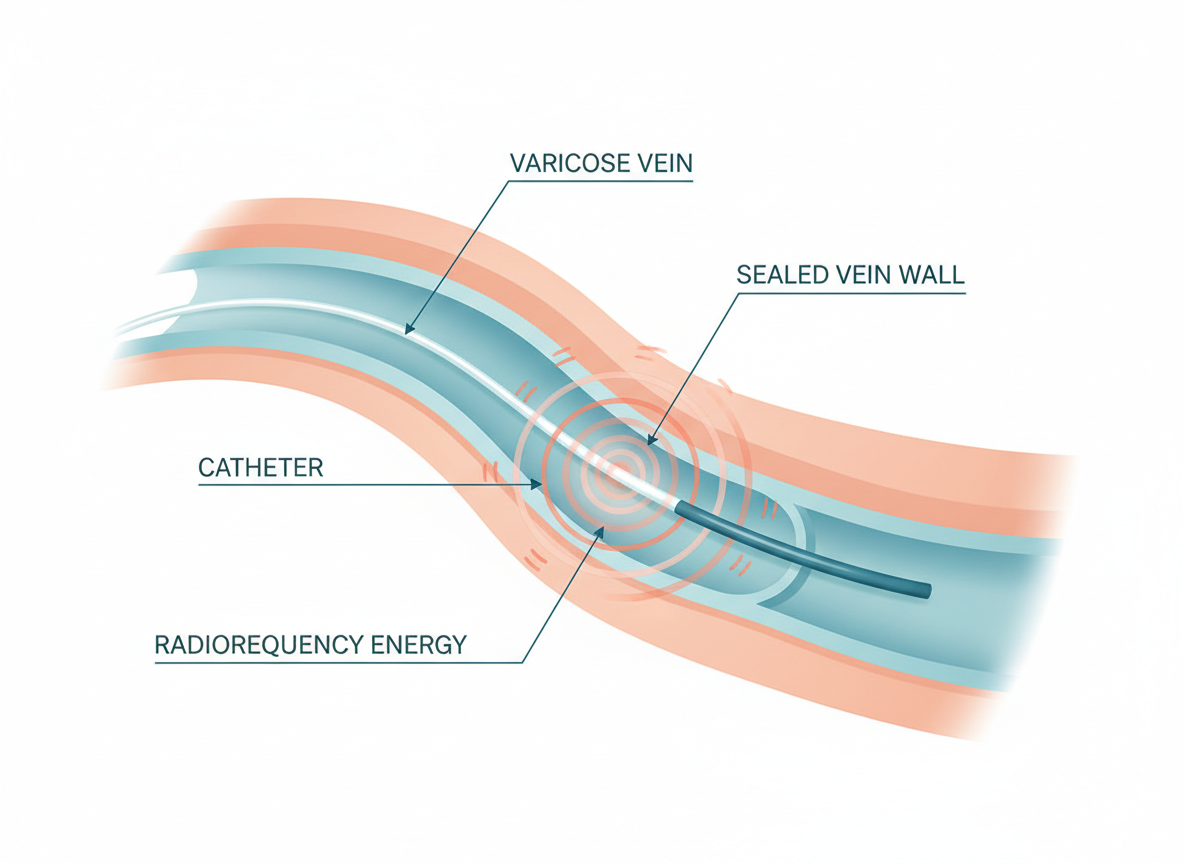
Radiofrequency ablation (RFA) is one of the most widely used and well-established treatments for varicose veins. It works by delivering controlled radiofrequency energy (heat) to the wall of the affected vein through a thin catheter, causing the vein to seal shut. Once sealed, blood is naturally rerouted through healthy veins nearby.
The procedure targets the underlying cause of varicose veins — venous reflux — rather than simply removing visible surface veins. By closing the main refluxing vein, the pressure that causes bulging, aching, and skin changes is eliminated at source.
Why do varicose veins need treating?
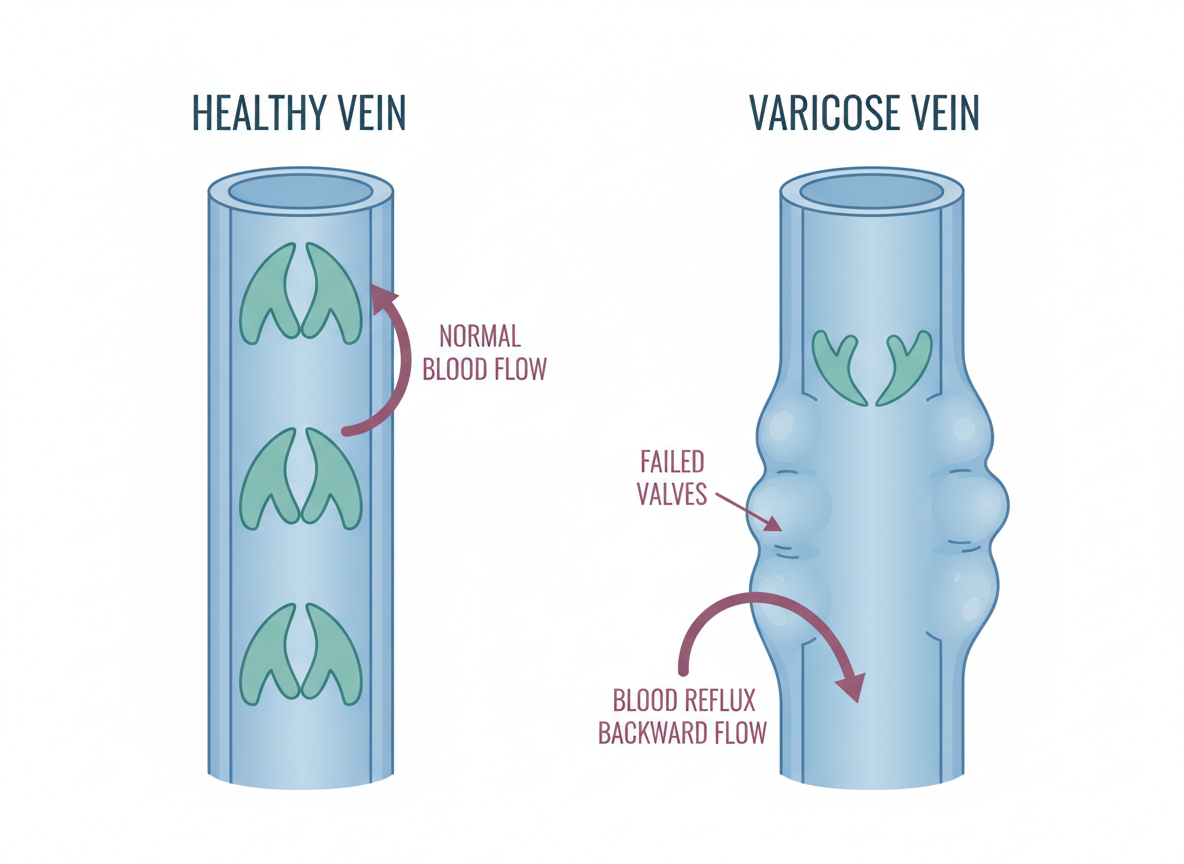
Varicose veins develop when the one-way valves inside your leg veins stop working properly. Normally, these valves prevent blood from flowing backwards. When they fail, blood pools in the vein, causing it to stretch, bulge, and become visible beneath the skin.
Left untreated, this ongoing pressure can lead to worsening symptoms — including aching, swelling, skin discolouration, venous eczema, and in some cases, leg ulcers. RFA addresses the root cause by permanently sealing the faulty vein.
Key facts about RFA
- Technology
- Medtronic ClosureFast system — the most widely used RFA device worldwide
- Anaesthetic
- Local anaesthetic only — no general anaesthetic required
- Duration
- Typically 30–45 minutes per leg
- Setting
- Day-case procedure — walk-in, walk-out
- Scarring
- Minimal — a single needle puncture, no surgical incision
What happens during the procedure
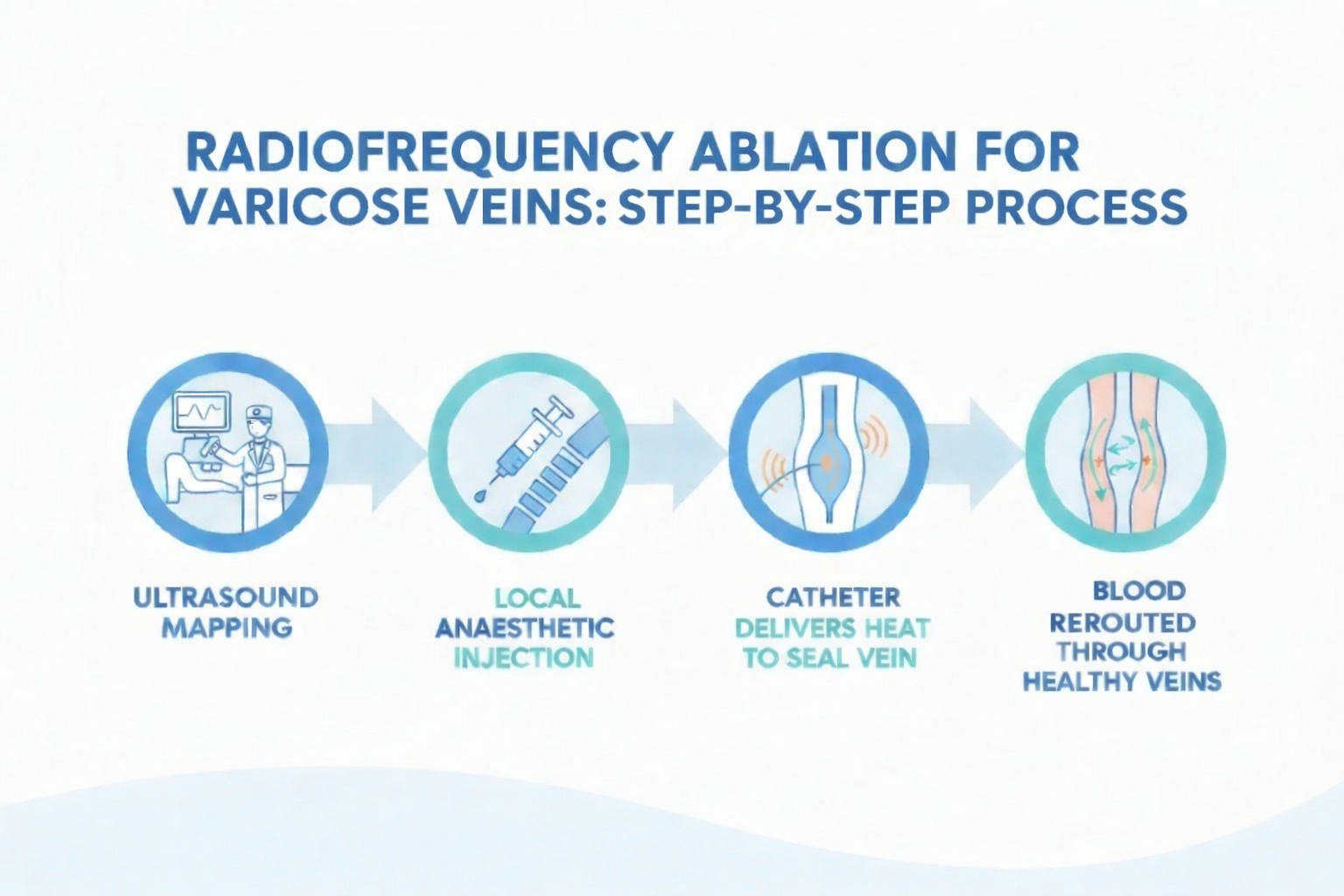
RFA is a straightforward, well-established procedure. Here is what to expect on the day, step by step.
Duplex ultrasound mapping
Before the procedure, a specialist vascular scientist performs a duplex ultrasound scan to map the affected veins and confirm exactly where the valves are failing. This ensures the treatment is precisely targeted.
Local anaesthetic
The area around the vein is numbed using local anaesthetic, injected under ultrasound guidance. This is called tumescent anaesthesia. You stay awake and comfortable throughout — there is no need for a general anaesthetic or sedation.
Catheter insertion and treatment
A thin catheter is inserted into the vein through a tiny needle puncture (usually just below the knee or at the ankle). Using ultrasound to guide the catheter into position, controlled radiofrequency energy is delivered along the vein wall, sealing it shut segment by segment.
Immediate recovery
Once the vein is sealed, the catheter is removed and a small dressing is applied. You can stand up and walk immediately. A compression stocking is fitted, and you are free to go home — usually within an hour of the procedure finishing.
Performed under local anaesthetic — no general anaesthetic needed
One of the key advantages of RFA is that it is performed entirely under local anaesthetic. This means you avoid the risks associated with general anaesthesia (such as nausea, drowsiness, and the need for a longer recovery period). You remain awake and comfortable throughout, and can drive yourself home afterwards in most cases.
The tumescent anaesthetic also serves a second purpose: it creates a protective fluid cushion around the vein, shielding surrounding tissue from the heat and improving the effectiveness of the seal.
Risks and side effects
Radiofrequency ablation is a safe, well-established procedure with a strong track record. Like any medical treatment, it carries some risks. Most side effects are mild and temporary. Serious complications are rare.
Your surgeon will discuss these with you before the procedure and answer any questions. Understanding the risks is an important part of making an informed decision.
Common side effects
These are expected and usually resolve on their own within days to weeks.
Some bruising along the treated vein is normal and expected. It usually fades over one to two weeks.
A pulling or tight sensation along the treated vein is common in the first few days. Over-the-counter painkillers are usually sufficient.
Small sensory nerves near the treated vein may be temporarily affected by the local anaesthetic or heat. This usually resolves within weeks to months.
A brownish discolouration may develop along the line of the treated vein. This typically fades over several months.
Less common and rare risks
These occur infrequently but are important to be aware of.
The treated vein can become inflamed and tender. This is usually self-limiting and responds to anti-inflammatory medication and compression.
There is a small risk that heat from the catheter could extend into the deep veins, potentially causing a DVT. This is rare and is minimised by careful ultrasound-guided technique and post-procedure checks.
The tumescent anaesthetic creates a protective cushion around the vein, making thermal skin injury very unlikely. In rare cases, a small superficial burn may occur.
As with any procedure involving a needle puncture, there is a very small risk of infection at the entry site. Sterile technique minimises this risk.
Persistent numbness or altered sensation in the treated area can occur if a sensory nerve is affected. This is uncommon and usually temporary.
In a small number of cases, the treated vein may not seal completely or may reopen over time. A follow-up scan will check the result, and further treatment can be arranged if needed.
How we minimise risk
Every step of the procedure is performed under real-time ultrasound guidance, ensuring precision and safety.
The local anaesthetic fluid creates a protective cushion around the vein, shielding surrounding tissue from heat.
A follow-up duplex ultrasound confirms the vein has sealed successfully and checks for any complications.
Recovery and what to expect afterwards
One of the biggest advantages of RFA is the rapid recovery. Because it is performed under local anaesthetic with no surgical incision, most patients are back to their normal routine very quickly.
Recovery timeline
Walk-in, walk-out — no overnight stay
RFA is a true day-case procedure. You arrive at the hospital, have the treatment, and go home the same day — usually within a couple of hours. There is no overnight stay, no general anaesthetic recovery, and no need for someone to collect you in most cases. Many patients are pleasantly surprised by how straightforward the experience is.
Frequently asked questions
Answers to the questions patients most commonly ask about radiofrequency ablation.
Is RFA painful?
Most patients describe the local anaesthetic injections as the most uncomfortable part — similar to a dental injection. Once the area is numb, the procedure itself is painless. Afterwards, mild aching or tightness is common for a few days but is usually well managed with paracetamol or ibuprofen.
Can I drive home after the procedure?
In most cases, yes. Because RFA is performed under local anaesthetic (not general anaesthetic or sedation), most patients are able to drive themselves home. Your surgeon will confirm this on the day.
How soon can I return to work?
Most people return to desk-based work within one to two days. If your job involves heavy lifting or prolonged standing, your surgeon may recommend a slightly longer break — typically up to a week.
Will I need time off exercise?
Walking is encouraged from day one. Light exercise can usually be resumed within a few days. More strenuous activities (running, gym, swimming) are typically fine after one to two weeks, depending on your surgeon's advice.
What happens to the sealed vein?
The sealed vein is gradually absorbed by the body over the following weeks and months. Blood is naturally rerouted through healthy veins — your circulation actually improves because blood is no longer pooling in the faulty vein.
Will I need more than one treatment session?
Some patients need only RFA. Others benefit from additional treatments (such as foam sclerotherapy or avulsions) to address smaller branch veins. Your surgeon will explain the full plan after your scan, so there are no surprises.
Is RFA suitable for everyone?
RFA is suitable for most patients with varicose veins caused by venous reflux. Your duplex ultrasound scan will confirm whether RFA is the right approach for your particular vein pattern. In some cases, an alternative treatment may be more appropriate.
Considering radiofrequency ablation?
The first step is a consultation and duplex ultrasound scan to confirm whether RFA is the right treatment for your veins. Initial consultations are typically available within five days.
If you have urgent symptoms (e.g. sudden leg swelling, significant bleeding from a varicose vein), please seek urgent NHS assessment via 111 or A&E.